
August 27, 2026
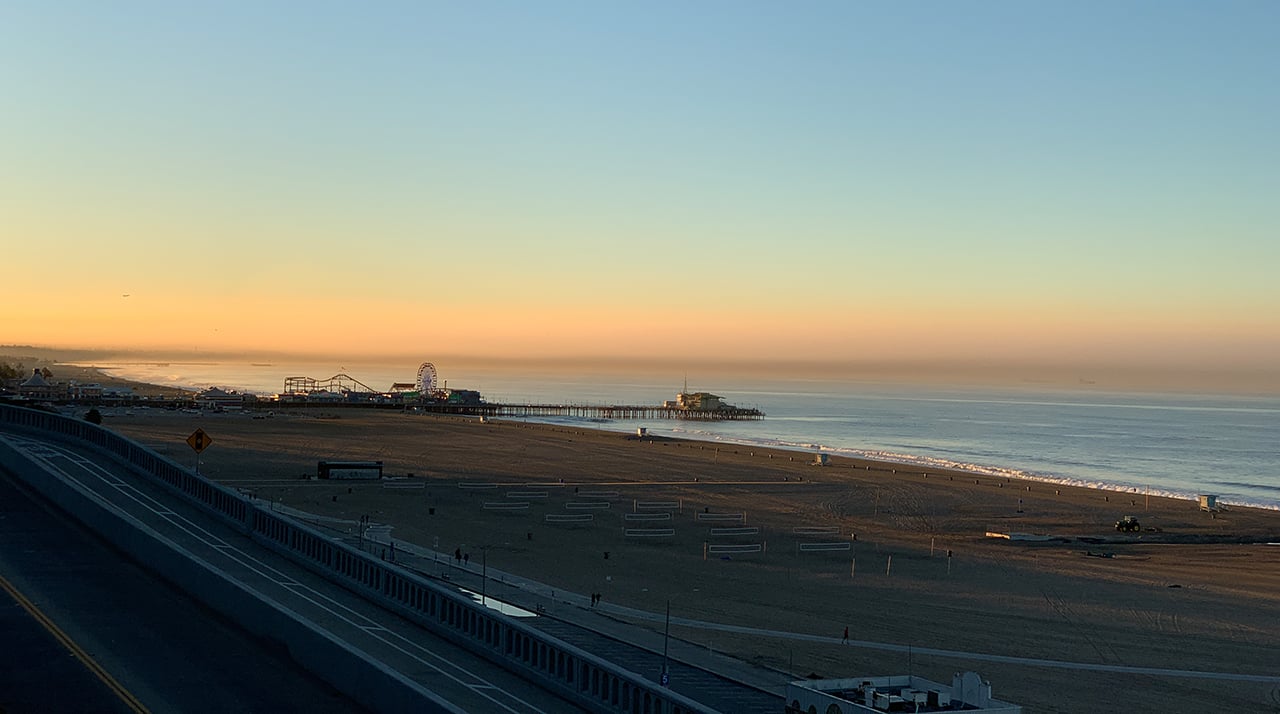
Walk the bluff-top path along Ocean Avenue on any clear evening and you'll get the same view that's made Palisades Park a postcard for more than a century: the Pacific flattening out toward the horizon, the pier lights coming on below, palm silhouettes stacked against the fading sky. It's easy to assume a stretch of oceanfront this good simply never got built on because someone with foresight decided to protect it. That's not quite what happened. The land was given away in 1892 because the people who owned it couldn't build on it. It was too unstable.
That single fact, easy to miss on a stroll, is still doing quiet work in the park today. It explains why the ground squirrels making local news this year matter more than a cute nuisance story. It explains why city crews keep showing up with new benches and drought-tolerant shrubs. And it explains why the park you're walking through has always required more maintenance than its calm surface lets on.
Palisades Park's earliest section came from city founders John Percival Jones and Arcadia Bandini de Baker, who donated the bluff-top strip in 1892. At the time it was known as Linda Vista Park, a name it kept until 1915. The reason the land became a park instead of a row of oceanfront homes wasn't civic generosity so much as geology: the bluff sits on an uplifted, unconsolidated sedimentary terrace, the kind of ground that has never been particularly good at holding weight.
More than a century of engineering has gone into managing that instability. A city study prepared years ago described the bluff face in blunt terms, calling it a fragile formation prone to slope failures from poor drainage, groundwater seepage, earthquake shaking, and burrowing animals. The fixes on the table have included soil nailing, which involves drilling forty-foot steel rods into the bluff face and grouting them in place, and hydraugers, drainage pipes designed to relieve water pressure inside the slope before it fails. None of this is visible from a bench with an ocean view. All of it is the reason the bench, and the view, are still there.
This past spring and summer, Palisades Park became briefly famous for a different reason: its ground squirrels. Local and national outlets covered the story after the population swelled to the point that city officials asked visitors to stop feeding them. Marcia Rybak, director of Coast and Canyon Wildlife Rehabilitation, put the cause plainly in an interview with CBS Los Angeles: "The problem is, it's always the food supply." City officials confirmed the pattern to reporters, noting that they typically see an increase in the squirrel population every spring and summer as part of the animals' natural mating cycle, a cycle that human snacks have been supercharging. Tati Simonian, the city's public information officer, has said the park's heavy foot traffic sits right on top of the bluffs the squirrels call home, which is part of why the two keep colliding.
The detail that connects this story back to the bluff itself is easy to overlook: those same burrowing habits are named, alongside groundwater seepage and earthquake shaking, as one of the contributing causes of slope failure. A charming photo opportunity and a geotechnical liability are, on this particular stretch of coastline, the same animal. In early June, a Santa Monica photographer documented a feral cat stalking and capturing a young squirrel along the bluff edge, evidence of an informal predator check that volunteers maintain through trap-neuter-return efforts rather than any coordinated city program. It's an unplanned piece of the balance that keeps the burrow population from running further out of control.
While the squirrel story was making headlines, the city's Public Landscape Division was doing the less dramatic version of the same job: keeping the park's surface functional. A springtime update from the department walked through a handful of specific fixes. At Inspiration Point, on the park's north end, staff replaced eight damaged trash cans. Farther south near San Vicente Boulevard, they installed a new bench behind the Millennium Wall. And at the Montana Avenue crossing, aging shrubs were swapped out for drought-tolerant Natal plum, a species chosen specifically to hold up to coastal exposure with less water.
None of these changes will show up in a tourist's photo of the sunset. They're the kind of maintenance that only registers if you walk the same stretch of path every week, which is exactly the audience this kind of update is written for. The park spans 26 acres and roughly two miles from Adelaide Drive at the north end down to Colorado Avenue, and it holds 192 benches, 102 trash cans, and 27 picnic tables, according to the city's own count. Keeping that inventory in working order, on ground that shifts, is a permanent job, not a one-time project.
Because the ocean view does most of the talking, a lot of the park's specific history gets skipped over on a normal walk. A few things worth slowing down for:
None of these require an admission fee or an event calendar. They're simply there, waiting for someone walking past to notice.
For everything unstable about the ground underneath it, the park's weekly pattern is remarkably steady. The pétanque courts see regular use most afternoons. The rose garden, planted near the bust of Arcadia Bandini de Baker, draws its own quiet crowd of photographers chasing one good bloom. On Sunday afternoons from 3 to 6 p.m., the Sun Canyon Band plays a live set that's become enough of a fixture that regulars plan their walk around it, blanket and picnic in tow.
This is the version of Palisades Park that has nothing to do with soil nails or squirrel burrows: a place where people run before work, walk dogs on a loop they've done a hundred times, and sit for a jazz set on a Sunday. It's also, structurally speaking, standing on ground the city has spent well over a century working to keep in place, one drainage improvement and one shrub replacement at a time.
That's the piece of the story that doesn't make it into a squirrel headline or a five-star review. The park exists because a plot of oceanfront land was, in the plainest sense, too risky to build on. Everything that's happened here since, the pergola, the gate, the jazz series, the ongoing fight against erosion, the sudden fame of its ground squirrels, is downstream of that one fact about the ground itself. Next time you're on the path near the Millennium Wall or passing the new Natal plum near Montana, you're standing on a piece of the Santa Monica coast that was saved from development by its own instability, and has been quietly, expensively held together ever since.
If you're the kind of Santa Monica resident who notices these details on your own walk through the park, you already understand something about this neighborhood that doesn't show up in a listing description. That kind of local knowledge is exactly what Team Pinckert brings to every conversation with Westside homeowners, whether you're weighing a move this year or simply curious what your home is worth in today's market. Reach out when you're ready to talk it through.
Stay up to date on the latest real estate trends.

Because a home isn’t just an investment—it’s a place to build a life. Markets fluctuate, but our commitment to service, loyalty, and excellence remains steady.