
Market News July 2, 2026
Thinking about leaving a larger Brentwood home, but not ready to leave Brentwood behind? You are not alone. For many homeowners, downsizing is less about giving something up and more about simplifying daily life while staying close to the routines, streets, and local places that already feel like home. This guide will help you understand how Brentwood condos and townhomes fit that move, what to watch for, and how to evaluate your options with confidence. Let’s dive in.
Brentwood offers a strong case for right-sizing without a major lifestyle reset. City Council District 11 notes that Brentwood is home to nearly 42,000 residents and highlights neighborhood features like scenic trails, the San Vicente coral-tree median, and established local anchors.
If you already know and love the area, that matters. Brentwood includes everyday destinations like the Brentwood Farmer's Market, the Donald Bruce Kaufman Brentwood Branch Library, Barrington Recreation Center, Crestwood Hills Recreation Center, and Mandeville Canyon Park, which can make the transition from a larger home feel more seamless.
For many downsizers, the real goal is continuity. You may want less upkeep, fewer unused rooms, and a more manageable property without giving up your familiar coffee run, market stop, or neighborhood rhythm.
Brentwood's condo and townhome market is broad enough to support very different versions of downsizing. Current listing snapshots show 62 condo or apartment listings and 31 townhome listings, which suggests buyers can often compare multiple ownership styles and price points at the same time.
The price and size range is just as wide. Visible condo listings range from a 1-bedroom, 686-square-foot unit at $495,000 to a 4-bedroom, 4,558-square-foot residence at $2.89 million, while townhome examples range from a 2-bedroom, 1,157-square-foot home at $850,000 to a 3-bedroom, 4,208-square-foot home at $4.49 million.
That spread is important because downsizing does not always mean moving into something small. In Brentwood, it can mean trading yard work and extra maintenance for a lock-and-leave setup, a more efficient layout, or a home with shared amenities and less hands-on responsibility.
Brentwood remains a high-value market, which shapes how many owners think about timing and tradeoffs. Zillow's Brentwood home-value index was $2,856,036 as of May 31, 2026, up 4.7% over the prior year, while Redfin reported a median sale price of $2,249,243 over the three months ending May 2026 and 70 days on market.
These numbers should be viewed as complementary snapshots, not direct apples-to-apples comparisons, because they use different datasets and time periods. Still, they show a market where attached homes can offer a path to staying in Brentwood with a different footprint and maintenance profile.
Brentwood is also described by Redfin as moderately walkable, with a Walk Score of 52. For some buyers, that supports a stay-local lifestyle where certain errands and neighborhood outings remain close at hand.
One of the biggest mistakes downsizers make is assuming that condo and townhome mean the same thing. In California, they do not.
According to the California Department of Real Estate, a condominium is a legal form of ownership. You own a separate interest in your unit along with an undivided interest in the common area.
A townhome, by contrast, is an architectural term, not a legal one. A home that looks like a townhome may legally be a condo or part of a planned development, and that can affect maintenance duties, common-area rules, and how the homeowners association is structured.
Two homes can look nearly identical from the street but come with very different responsibilities. The California DRE notes that patios, balconies, driveways, and parking spaces may be classified as exclusive-use common area rather than fully deeded private property.
That distinction can shape your day-to-day experience. Before you buy, you will want to know exactly who maintains the roof, siding, landscaping, driveways, and exterior systems, rather than assuming the exterior is fully handled for you.
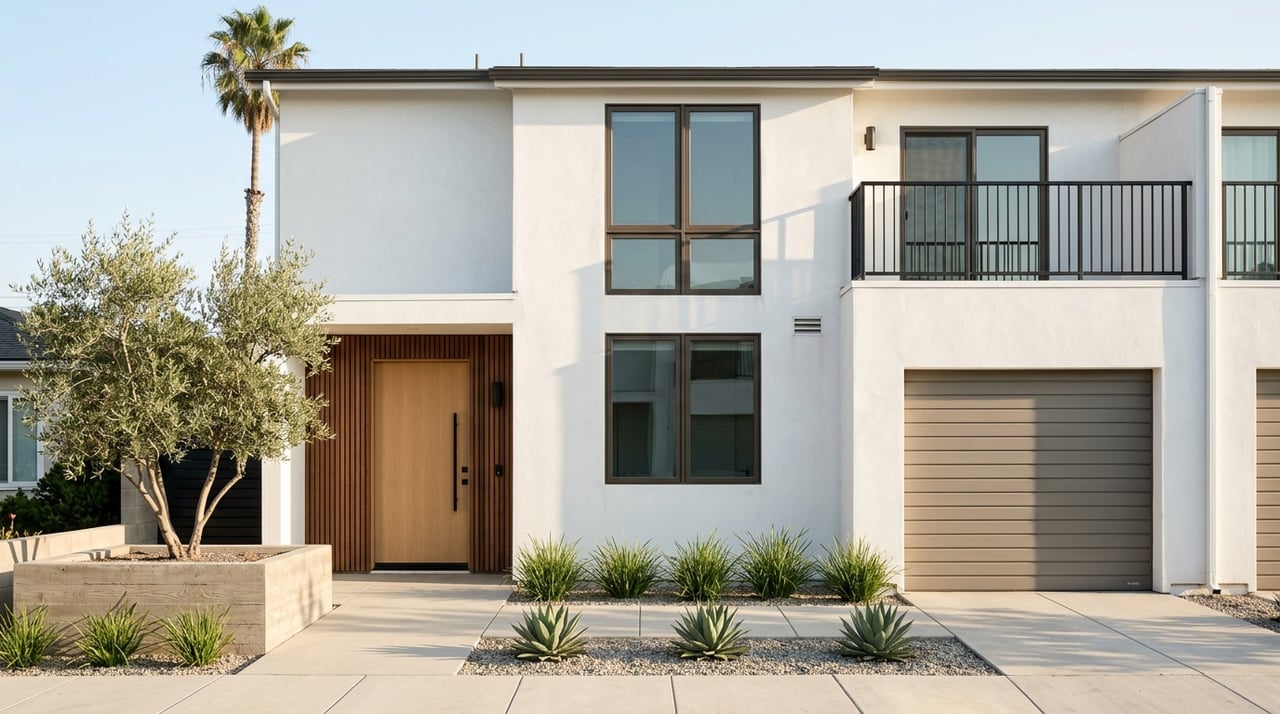
In Brentwood, downsizing is often more about simplifying than shrinking. You might move from a single-family home into a residence that still offers a patio, balcony, attached garage, or house-like floor plan, but with fewer chores and less exterior maintenance.
That is why it helps to define your goal before you start touring homes. Do you want to eliminate yard work, reduce stairs, cut down on storage, or move away from formal rooms you rarely use?
Your answer will shape the right search. Some buyers want a compact, low-key unit in a quiet courtyard building, while others prefer a larger townhome or full-service residence that preserves square footage but changes the maintenance burden.
A lower-maintenance home does not always mean a lower monthly payment. To compare options clearly, you need to look at the full housing cost, not just the asking price.
That means combining your mortgage, property taxes, insurance, and HOA dues. HOA dues are typically paid separately from the mortgage, and insurance obligations may be split between the HOA's master policy and your own individual coverage.
HOA dues can vary widely. The research shows they can range from a few hundred dollars per month to more than $1,000, and Brentwood listings illustrate that spread clearly.
For example, one older townhome advertises roughly $175 in HOA dues, while another townhome in Mountaingate lists about $2,469 in dues. That difference often reflects a very different building culture, service level, and maintenance scope.
Not every attached home offers the same lifestyle. Some Brentwood properties are quiet low-rise buildings with limited shared amenities, while others are guard-gated communities or full-service residences with staffed services and a more structured living environment.
That can affect more than cost. It can also influence privacy, guest access, parking, pet rules, noise expectations, and how much interaction you have with neighbors or building staff.
For many downsizers, this is just as important as square footage. A home that works on paper may not feel right if the pace, rules, or level of activity does not match how you actually live.
In California common-interest developments, the document review stage is especially important. The California DRE says public reports for new subdivisions and common-interest developments include CC&Rs, costs and assessments, and other material disclosures, and these must be delivered before a buyer becomes obligated.
Even beyond new projects, reviewing the governing documents early can save you time and stress. You want a clear picture of both the rules and the building's financial health before you get emotionally attached to a unit.
Before moving forward, make time to review:
These materials can reveal whether the HOA is planning well for future repairs, how rules are enforced, and whether upcoming costs may affect your budget.
Reserve planning matters because shared buildings age, even when individual units look beautifully updated. California DRE reserve-study guidance says reserves should estimate major common-area repairs and replacements such as roofs or pavement.
The DRE also notes that assessments can rise over time, and conversion projects may uncover larger-than-expected maintenance needs. For a downsizer, that means the right question is not just whether the home looks turnkey today, but whether the project appears prepared for tomorrow.
A well-run building can support a smoother ownership experience. A poorly funded one can create surprise costs and frustration, even if the unit itself checks every box.
If you are financing your purchase, attached homes can involve more project-level review than detached homes. Fannie Mae project standards show that lenders may examine legal documents, budgets, reserve studies, insurance evidence, and condominium questionnaires.
Eligibility can also be affected by project-level issues, including litigation or incomplete project status. In most condo projects, master property insurance for common elements and residential structures is also required unless the legal documents say otherwise.
This is one reason preparation matters. When you find a Brentwood condo or townhome you like, you want to understand not only the unit but the project behind it.
If you are trying to narrow the field, this simple framework can help you compare homes more clearly.
Be specific about what you want to stop managing. Your ideal move may be about giving up a yard, reducing storage, simplifying maintenance, or keeping only the rooms you truly use.
Add mortgage, property taxes, insurance, and HOA dues together. This gives you a more realistic picture than list price alone.
Read the HOA documents before you get too attached. They can quickly tell you whether the property fits your lifestyle and budget.
Ask who handles the roof, siding, landscaping, driveways, balconies, and exterior systems. Similar-looking homes can divide those responsibilities very differently.
Think about how the building feels day to day. The right fit depends on your preferences around privacy, amenities, guests, parking, pets, and overall pace.
For many homeowners, the appeal of Brentwood condos and townhomes is not just efficiency. It is the chance to keep your connection to a neighborhood you already know while reshaping your home around how you want to live now.
That might mean a compact condo near familiar commercial corridors, a larger townhome with garage space and outdoor areas, or a full-service residence that shifts more responsibility off your plate. In a neighborhood with broad attached-home options and established local anchors, downsizing can be a lifestyle decision that feels thoughtful rather than abrupt.
If you are weighing that move, a clear understanding of ownership structure, monthly cost, HOA health, and building culture can help you choose with much more confidence.
If you are considering a move within Brentwood and want practical guidance tailored to your goals, Team Pinckert brings a calm, local, relationship-first approach to helping you evaluate the right next step.
Stay up to date on the latest real estate trends.
Before & After
Market News
Market News

Market News

Market News
Market News
Market News
Because a home isn’t just an investment—it’s a place to build a life. Markets fluctuate, but our commitment to service, loyalty, and excellence remains steady.